
Based on the practical implementation of the Land Law after two years, the draft amendment to the Land Law submitted to the National Assembly dated October 9, 2026 (hereinafter referred to as the “Draft”) is formulated to replace the Land Law 2024 and is expected to take effect from March 1, 2027. Based on the Draft and the comparative summary table with the Land Law 2024 by the Department of Land Management (Ministry of Agriculture and Environment), we have selected ten (10) new points in the Draft Amended Land Law 2026, highlighting regulatory orientations with the most significant impact on investors and real estate enterprises. From DIMAC’s perspective in real estate legal consulting, we believe the following points will determine the speed of site clearance and the input costs of projects in the coming period.
Land recovery and land allocation schedule: expanding scope, flexibility in timing
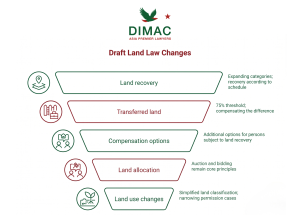
New Point 1 – Expanding the categories of land recovery for national and public interests:
The Draft adds several cases eligible for land recovery: concentrated digital technology zones; projects within free trade zones and international financial centers; logistics centers serving seaports, airports, and inland waterways with a scale of over 50 hectares; and land recovery to implement international treaties.
The Draft also allows land recovery to create land funds for leasing to organizations whose land was recovered for national defense, security, and socio-economic development purposes to continue their production and business operations; specifically, the land fund for compensating BT (Build-Transfer) projects is synchronously amended in the Law on Public-Private Partnership Investment to ensure that land allocation and leasing for the implementation of reciprocal projects of BT projects are not subject to auction or bidding.
Regarding the grounds for recovery, the Draft no longer links land recovery to the annual district-level land use plan; a project only needs to be included in the list of land recovery approved by the provincial People’s Council, or have an investment decision, a decision approving the investment policy from the competent authority, or be a special or urgent public investment project (these projects are exempt from passing through the list).
New Point 2 – Land recovery and allocation according to schedule, without waiting for the completion of site clearance:
Land recovery is carried out according to the schedule of the investment project or the schedule of compensation, support, and resettlement. Land allocation and land leasing are also decided according to the project schedule or the land recovery schedule.
Notably, for land currently in use, the Draft only requires a land recovery decision prior to allocating it to others (except in cases of transferring real estate projects and allocating land from the developmental reserve land fund), and no longer stipulates the condition of completing compensation, support, and resettlement as required in the Land Law 2024; in cases where resettlement arrangements are not required, the land recovery decision can even be issued prior to the approval of the compensation plan for projects of national importance, urgent public investment projects, projects agreed upon by over 75% of land users, or when land users voluntarily hand over the site. In our view, this allows large-scale projects to receive land and implement development in phases.
Projects receiving transferred land use rights: mechanism to “lock in” the remaining area
New Point 3 – Land recovery for projects receiving transferred land use rights (75% threshold):
This is the most notable new point for housing and urban projects in the draft amended land law. When the time limit or the extended time limit to complete the receipt of transferred land use rights expires, and the investor has received transfers for over 75% of the land area and from over 75% of the land users, the provincial People’s Council shall consider and approve the recovery of the remaining area to allocate or lease to the investor. This recovered land fund is allocated or leased without auction or bidding. This mechanism resolves situations where a minority of non-consenting households stall the entire project, but it requires the investor to prove the ratio of successfully transferred rights directly from the dossier preparation stage.
New Point 4 – Compensating the difference for persons subject to land recovery in projects receiving transferred land use rights:
If the compensation amount calculated per area unit under the compensation plan is lower than the average agreed-upon land price, the person whose land is recovered is entitled to receive the shortfall. The investor shall advance the funding, including this difference, and this difference shall be accounted for in the project’s investment costs. Thus, investors need to determine the average agreed price for the recovered area as the minimum compensation cost to incorporate into the project’s preliminary total investment estimate from the outset.
New Point 5 – Reducing certain conditions for receiving transferred land use rights to implement projects; ensuring continued implementation for cases of receiving project transfers:
Compared to Article 127 of the Land Law 2024, Article 59 of the Draft no longer restricts commercial housing projects to only receiving transferred residential land use rights, nor does it retain conditions regarding conformity with district-level planning, investor conditions, and written approval from the provincial People’s Committee.
Investors who have received land use rights but have not completed procedures upon the expiration of the time limit may continue to implement the project without requiring an extension. Foreign-invested economic organizations receiving real estate project transfers under the amended Law on Real Estate Business shall continue to be allocated or leased land without undergoing auction or bidding.
Compensation and resettlement: changing price determination methods, adding more options
New Point 6 – Additional options for persons subject to land recovery:
Persons whose land is recovered may be considered for compensation with land of a different purpose or with housing when the locality has available land or housing funds. Land users may request the recovery of the remaining area of a land parcel, no longer restricted to cases where the remaining area is smaller than the minimum prescribed area as in the Land Law 2024; the recovery, compensation, and support for this remaining area shall be carried out in accordance with Government regulations. The provincial People’s Council is authorized to decide on specific compensation, support, and resettlement policies for projects decided or approved by the National Assembly or the Prime Minister that cause the relocation of entire residential communities; resettlement areas must meet at least the new rural standards or urban standards. These changes in compensation, support, and resettlement regulations, if passed by late 2026, will increase compensation options between Investors and affected persons, which is expected to significantly shorten site clearance time.
Land allocation and land lease: maintaining competition, reducing inappropriate conditions
New Point 7 – Auction and bidding remain core principles, but exceptions are expanded to attract investment to projects in areas with extremely difficult socio-economic conditions and other cases to remove bottlenecks in auctions and bidding.
Projects using land funds recovered by the State or managed by State agencies/organizations shall be allocated or leased through auction, except in cases where auction is exempted by Law. Bidding applies to large-scale, complex urban and rural residential projects with requirements for planning, architectural, or landscape highlights, or that play a crucial role in the locality; the provincial People’s Council shall stipulate criteria and decide on the application of bidding.
Regarding exceptions, the Draft allows land allocation and leasing without auction or bidding for energy and tourism projects located entirely in areas with extremely difficult socio-economic conditions; land put up for auction where, upon the expiration of the registration period, only one person registers, participates, bids, or makes a valid bid may also be allocated without auction; land auctioned twice unsuccessfully due to no participants shall be considered for allocation without auction per Government regulations, and is no longer subject to the 12-month limit as in the Land Law 2024.
New Point 8 – Proactively choosing the form of land lease and changing the form of land use.
The Land Law 2024 set one-off rental payments as the default for many groups (agricultural production, industrial zones, commerce, tourism services, offices, social housing for rent). The Draft reverses this: land lessees may choose either one-off or annual payments when applying for a land lease, without any group being strictly required to make a one-off payment; specifically, investors of infrastructure business projects wishing to switch from one-off to annual payments must obtain the consent of all secondary investors who have subleased land with one-off payments on the transitioned area. For projects with long-term cash flows, this is a vital tool for Investors to arrange financing and attract large investment projects.
Changing the purpose of agricultural land use: reducing administrative procedures
New Point 9 – Simplified land classification:
The Draft groups agricultural land more concisely: arable land (including rice-growing land and other crop-growing land), forestry land, concentrated livestock-aquaculture land, and other agricultural land. Condensing agricultural land classifications will significantly reduce legal procedures concerning land, such as calculating agricultural land use fees, land statistics management, and administrative procedures that land users must perform when extending the land use term or applying for a change in land use purpose since smaller land categories have been merged into a larger one.
New Point 10 – Narrowing the cases requiring permission to change land use purpose:
Changing rice-growing land and forestry land to another land type within the agricultural group, and changing agricultural land to non-agricultural land, must still be carried out based on approval regulations by the competent state authority. However, the list of cases requiring permission has been reduced to only five groups, removing the group converting business-oriented public and career land into production and business land, and the group converting to commercial and service land as in the Land Law 2024. The remaining cases do not require permission but must comply with the commune-level land use plan. The Draft still notes that Economic organizations receiving transferred agricultural land must still have an approved land use plan, except in cases of implementing investment projects.
Overall Assessment
DIMAC observes that the draft amended and supplemented land law moves towards reducing procedures, empowering localities with more decision-making authority, and removing bottlenecks in project implementation, such as site clearance compensation for projects, and legal procedures implemented without extending schedules in certain specific cases. When the Draft is finalized alongside the Law on Housing and the Law on Real Estate Business expected in the National Assembly session at the end of this year, this will be the legal framework to promote project development and strongly attract investment in the coming time.
To optimize opportunities and control legal risks, enterprises should consult specialized real estate legal consulting units to timely update detailed regulations when the law is officially enacted.
Footnotes
[1] Article 107 of the Draft.
[2] Point a, Clause 4, Clause 5, Article 35 of the Draft.
[3] Point e, Clause 4, Article 35, Article 104 of the Draft.
[4] Clause 2, Clause 3, Article 36 of the Draft; Article 80 of the Land Law 2024.
[5] Clause 4, Article 36 of the Draft.
[6] Clause 4, Article 50 of the Draft.
[7] Article 51, Clause 3, Article 39 of the Draft; Article 117 of the Land Law 2024.
[8] Point i, Clause 4, Article 35 of the Draft.
[9] Clause 9, Article 56 of the Draft.
[10] Clause 4, Article 43 of the Draft.
[11] Article 59 of the Draft; Article 127 of the Land Law 2024.
[12] Point b, Clause 3, Article 59 of the Draft.
[13] Clause 8, Article 56, Clause 3, Article 53 of the Draft.
[14] Clause 2, Article 42 of the Draft.
[15] Clause 6, Article 42 of the Draft; Clause 7, Article 91 of the Land Law 2024.
[16] Clause 1, Article 43, Point a, Clause 2, Article 48 of the Draft.
[17] Clause 1, Article 57 of the Draft.
[18] Point a, Clause 1, Article 58 of the Draft.
[19] Point h, Clause 3, Clause 6, Article 56, Clause 3, Article 57 of the Draft; Clause 6, Article 124 of the Land Law 2024.
[20] Clause 1, Article 54, Clause 3, Article 26 of the Draft; Clause 2, Article 120 of the Land Law 2024.
[21] Clause 1, Article 9 of the Draft.
[22] Clause 1, Article 55 of the Draft; Clause 1, Article 121 of the Land Law 2024.
[23] Clause 3, Article 55 of the Draft.
[24] Clause 6, Article 28 of the Draft.
