
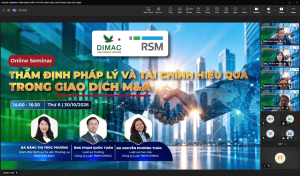
On October 30, 2026, DIMAC Law Firm LLC and RSM Vietnam successfully co-hosted an online seminar titled “Effective Legal and Financial Due Diligence in M&A Transactions,” attracting a large number of business representatives and investors from various industries.
As mergers and acquisitions (M&A) transactions increasingly require thorough preparation and comprehensive assessments, due diligence plays a critical role in identifying potential risks, determining business value, and protecting investors’ interests.
Through in-depth discussions from legal, financial, and tax perspectives, the seminar provided participants with practical insights into due diligence procedures, key considerations, and how due diligence findings can be translated into a sound basis for negotiation and successful M&A transactions.
1. Meet the Speakers and Industry Experts
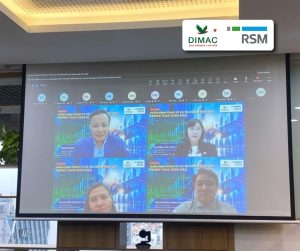
The seminar was moderated by Mr. Pham Quoc Tuan – Managing Partner, DIMAC Law Firm, with presentations delivered by the following speakers:
- Ms. Dang Thi Truc Phuong – Director of Deal Advisory Services, RSM Vietnam.
- Mr. Nguyen Danh Cong – Partner, DIMAC Law Firm.
- Ms. Nguyen Phuong Thao – Senior Associate, DIMAC Law Firm.
Drawing on their extensive expertise in legal advisory, financial advisory, and transaction consulting, the speakers offered complementary perspectives, providing participants with a comprehensive understanding of due diligence in M&A transactions.
2. Legal Due Diligence: Identifying Risks and Protecting Investors’ Interests
The seminar commenced with a presentation by Ms. Nguyen Phuong Thao – Senior Associate, DIMAC Law Firm, who discussed the role and importance of Legal Due Diligence (LDD) in M&A transactions.
Legal due diligence goes beyond verifying ownership rights and the legal status of a target company. It also enables investors to assess transaction feasibility, identify potential legal risks, and establish a sound basis for negotiating transaction agreements.
- The key areas requiring review during legal due diligence include:
- Capital structure and ownership;
- Licenses and business conditions;
- Land, real estate, assets, and intellectual property rights;
- Material contracts and loans;
In addition to identifying the key areas for review, the speaker introduced a six-step due diligence process from the Buyer’s perspective, comprising:
- Step 1: Defining the scope and areas of due diligence.
- Step 2: Requesting and verifying information.
- Step 3: Reviewing and identifying non-compliance issues or violations.
- Step 4: Assessing the level of risk.
- Step 5: Developing appropriate remedial measures.
- Step 6: Monitoring, updating, and addressing identified issues.
Through illustrative case studies, Ms. Nguyen Phuong Thao further explained how to assess the materiality of individual findings, address situations involving missing or incomplete information and documentation, and determine appropriate solutions based on the feasibility of mitigating identified risks.
The presentation also explored how due diligence findings can be translated into negotiation strategies and contractual provisions in a Share Purchase Agreement (SPA). A hypothetical scenario involving an investor acquiring 100% of the shares in a company operating in the software services sector was used to demonstrate how due diligence principles can be applied in actual transactions.
3. Financial and Tax Due Diligence: Looking Beyond the Numbers
Following the legal due diligence session, Ms. Dang Thi Truc Phuong – Director of Deal Advisory Services, RSM Vietnam, provided an in-depth perspective on Financial Due Diligence (FDD) and Tax Due Diligence (TDD).
3.1. Overview of the Financial and Tax Due Diligence Process
The speaker emphasized that although FDD and TDD approach a transaction from different perspectives, both share a common objective: providing a comprehensive assessment of a target company’s financial position, tax obligations, and potential risks that may affect investment decisions.
The due diligence process can be summarized into four key steps:
- Step 1: Understanding the target company and its business operations.
- Step 2: Collecting and analyzing financial information.
- Step 3: Identifying and assessing potential risks.
- Step 4: Preparing reports and providing recommendations.
The speaker also clarified the differences between a Financial Audit and Financial Due Diligence, helping participants better understand the respective objectives, scopes, and value of these activities in the context of M&A transactions.
3.2. Key Considerations in Financial Due Diligence
Financial due diligence goes beyond analyzing figures presented in financial statements. It requires a deeper assessment of the quality and sustainability of a company’s underlying value.
From determining Enterprise Value to Equity Value, Ms. Dang Thi Truc Phuong highlighted five key areas that investors should pay particular attention to:
- Quality of Earnings: Does EBITDA genuinely reflect the company’s sustainable earnings-generating capacity?
- Quality of Assets: Do the carrying values of assets accurately reflect their actual economic value?
- Net Debt: What significant financial obligations could affect the transaction value?
- Working Capital: How could fluctuations in working capital impact the purchase price?
Cash Flow: Are the reported profits actually being converted into cash?
- Cash Flow: Are the reported profits actually being converted into cash?
These considerations demonstrate that evaluating a business in an M&A transaction should not rely solely on figures presented in financial statements. Instead, investors need to examine the underlying substance of those figures and the company’s ability to sustain its business performance over time.
3.3. Identifying and Quantifying Tax Risks
From a tax due diligence perspective, the speaker emphasized that historical tax risks may translate into financial liabilities for a business in the future.
Some common tax risk areas in Vietnam highlighted during the seminar included:
- Corporate Income Tax (CIT);
- Value Added Tax (VAT);
- Foreign Contractor Tax (FCT);
- Personal Income Tax (PIT);
- Personal Income Tax (PIT);
- Related-party transactions; and
- The application of tax incentives.
In particular, the speaker stressed that a company’s completion of tax declarations and payments does not necessarily mean that it is free from tax exposure.
Therefore, investors should conduct thorough tax reviews to identify, assess, and quantify potential tax liabilities, providing a more informed basis for investment decisions.
3.4. From Due Diligence Findings to Transaction Negotiations
Another key takeaway from the presentation was that the true value of due diligence lies in translating findings into concrete decisions throughout the transaction process.
Accordingly, FDD and TDD findings can serve as a basis for:
- Evaluating and adjusting the purchase price;
- Allocating risks and responsibilities between the parties;
- Establishing mechanisms to protect investors’ interests;
- Incorporating due diligence findings into the Share Purchase Agreement (SPA); and
- Developing action plans to address outstanding matters following transaction completion.
The speaker concluded with an important message: Due diligence is not merely a tool for identifying risks; it is also essential for accurately assessing business value, making informed investment decisions, and protecting the value of an investment.
4. M&A Case Study: Bringing Together Legal, Financial, and Tax Perspectives
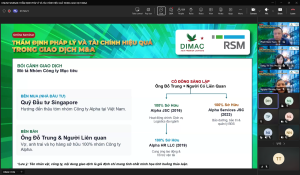
One of the highlights of the seminar was an interactive hypothetical case study jointly presented by DIMAC and RSM Vietnam
The scenario involved a foreign investor (the Buyer) seeking to acquire a group of domestic companies owned by an individual representative and related parties.
Through this case study, representatives from both firms jointly analyzed the transaction structure and key considerations from different professional perspectives:
- Legal Perspective – DIMAC Law Firm: Reviewing ownership structures, legal status, existing obligations, and potential risks that could affect the transaction.
- Financial and Tax Perspective – RSM Vietnam: Assessing the financial position, tax obligations, and other factors that could influence business valuation and investment returns.
By bringing together these complementary areas of expertise, the discussion helped participants better understand the relationship between legal, financial, and tax due diligence. It also demonstrated the importance of a comprehensive due diligence process in managing transaction risks and supporting informed investment decisions.
5. Q&A Session: Addressing Practical Challenges in M&A Transactions
The seminar concluded with a live Q&A session, providing participants with an opportunity to raise questions and exchange views directly with the speakers.
Representing DIMAC were Mr. Pham Quoc Tuan – Managing Partner, Mr. Nguyen Danh Cong – Partner, and Ms. Nguyen Phuong Thao – Senior Associate, alongside Ms. Dang Thi Truc Phuong – Director of Deal Advisory Services, RSM Vietnam.
The Q&A session not only provided further clarification on the professional topics covered throughout the seminar but also enabled participants to connect theoretical knowledge with practical business and investment scenarios through direct engagement with industry experts.
6. Closing Remarks
The seminar “Effective Legal and Financial Due Diligence in M&A Transactions” provided valuable insights into the role of due diligence throughout the M&A transaction lifecycle.
Through the combination of DIMAC’s legal advisory expertise and RSM Vietnam’s financial and tax advisory capabilities, the seminar once again highlighted the importance of comprehensive due diligence in identifying risks, assessing business value, supporting transaction negotiations, and safeguarding the interests of all parties involved.
DIMAC would like to extend its sincere appreciation to RSM Vietnam, all speakers, and participants for their valuable contributions and for making the seminar a success.
We hope that the knowledge and practical insights shared during the seminar will serve as a valuable reference for business readers
Watch the seminar replay here.: https://youtu.be/XXFVzC8ZZeM
